What determines the cost of a CNC part?
Material is purchased as stock, not just finished-part weight. Machining includes roughing, finishing, holes, threads, setups and inspection. Programming and setup can be batch costs. Identify treatment and outside services separately to avoid comparing a complete price with a partial estimate.
- Material: stock form, size, specification, cutting and procurement.
- Machining: removal time plus the time for other operations.
- Batch: programming, setup and any dedicated fixtures.
Removed volume is not total machine time
As a first estimate, subtract finished volume from stock volume using consistent units. Dividing by an assumed average removal rate gives an indicative removal time. It does not automatically include finishing, tool changes, non-cutting moves, extra setups or measurement. CAM and technical review improve the estimate.
- Removed volume = stock volume - finished-part volume, in cm³ here.
- Indicative removal time = removed volume / Q, where Q is in cm³/min.
- For milling: Q = ap × ae × vf / 1000, with depths in mm and feed in mm/min.
A worked example for a batch of ten
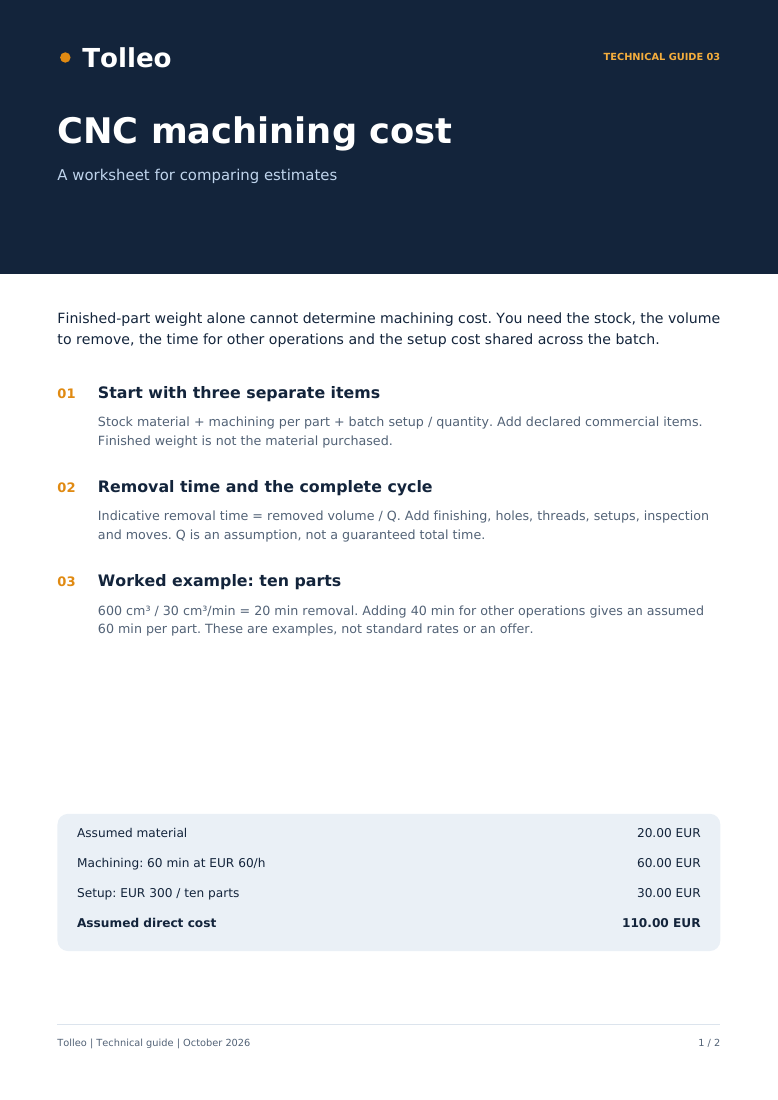
Assume 600 cm³ removed per part, Q of 30 cm³/min, 40 minutes for other operations, EUR 60/h, EUR 20 material per part and EUR 300 batch setup. Removal takes 20 minutes and the assumed total is 60 minutes per part. Direct cost is EUR 110 per part: 20 material, 60 machining and 30 allocated setup. A 35% markup gives EUR 148.50 per part or EUR 1,485 for ten.
- These are teaching assumptions, not standard market rates or a Tolleo offer.
- Markup on cost differs from profit margin on the selling price.
- VAT, transport, treatments and special fixtures are excluded.
Why quantity changes the unit price
With an unchanged cycle, EUR 300 setup contributes EUR 300 for one part, EUR 30 each for ten or EUR 3 each for one hundred. This allocation does not guarantee savings in every other item: material purchasing, inspection and organisation may change. Keep revision, quantity and scope fixed when comparing offers.
- Identify costs per batch and costs per part.
- Check that assumed stock allows suitable workholding.
- Compare scenarios, then submit the drawing for technical review.
This resource is informational. Requirements, feasibility and the inspection plan must be checked against the drawing and agreed for the supply.
Technical reference: Sandvik Coromant ↗